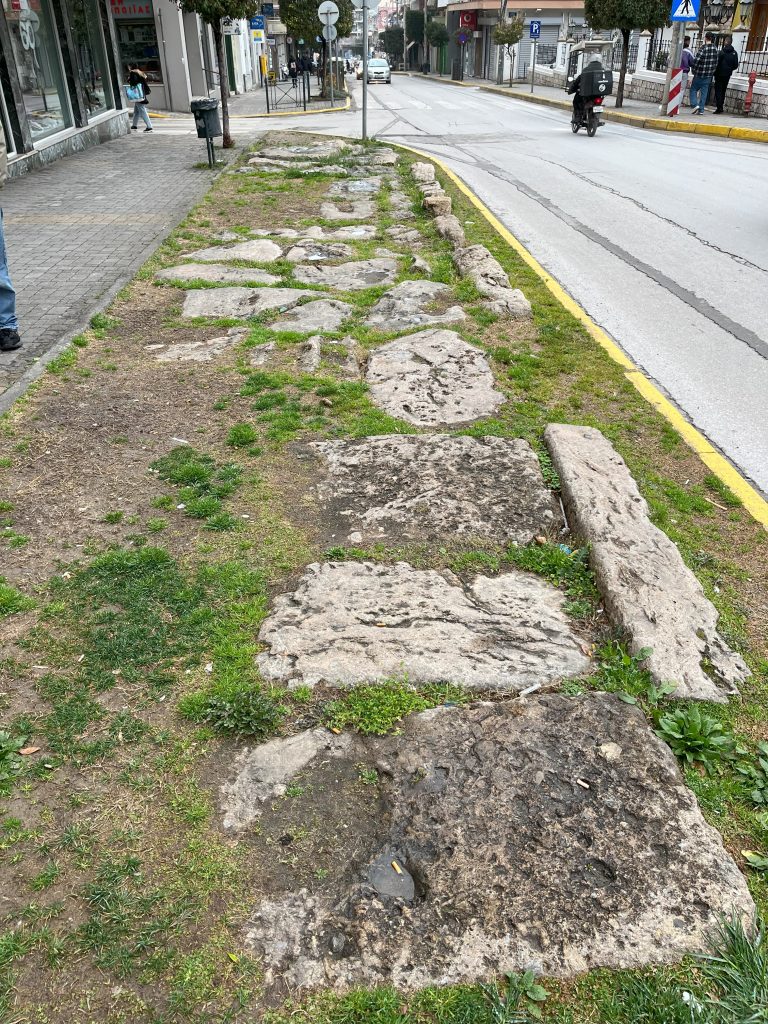
The modern Venizelou Street is built over the Roman road through the city. However, modern structures make it hard to decipher the ancient city plan or streets. Near it are the remains of the city’s earliest Christian remains at Hagios Patapios with a baptistery (Fourth Century) and a basilica (Fifth Century). The road bends at Mitropoleos Street along which are found four sections of ancient pavement. However, the two north ones were relocated from their original context. While Berea was not a city comparable to Thessalonica, it was important historically and geographically as well as the site of the koinon of Macedonia, the group that oversaw and promoted the Roman imperial cult activities within the province.1
Berea was home to a Jewish community as well.2 Paul began his ministry in the synagogue there and received a favorable response from its attendees who searched the Scriptures regarding the accuracy of Paul’s message with some believing. They were said to be more noble than the Jews of Thessalonica who, upon hearing that Paul and his companions were in Berea, also made the three-day journey to agitate and incite. This presupposes a relationship between the communities (Acts 17:10–13).
Created by GMT & JTS
Last updated 11/12/2025 JTS
- Mackil, Emily. “The Greek Koinon.” Essay. In The Oxford Handbook of the State in the Ancient Near East and Mediterranean, edited by Peter Fibinger Bang and Walter Scheidel, 304–23. New York: Oxford University Press, 2013. ↩︎
- Seven Jewish inscriptions dating to the Fourth Century AD were found in Veria; see Battinou, Zanet, ed. Corpus Inscriptionum Judaicarum Graeciae (CIJG): Corpus of Jewish and Hebrew Inscriptions from Mainland and Island Greece (late 4th c. BCE–15th century). Athens: Jewish Museum of Greece, 2018, pp. 101–15. ↩︎