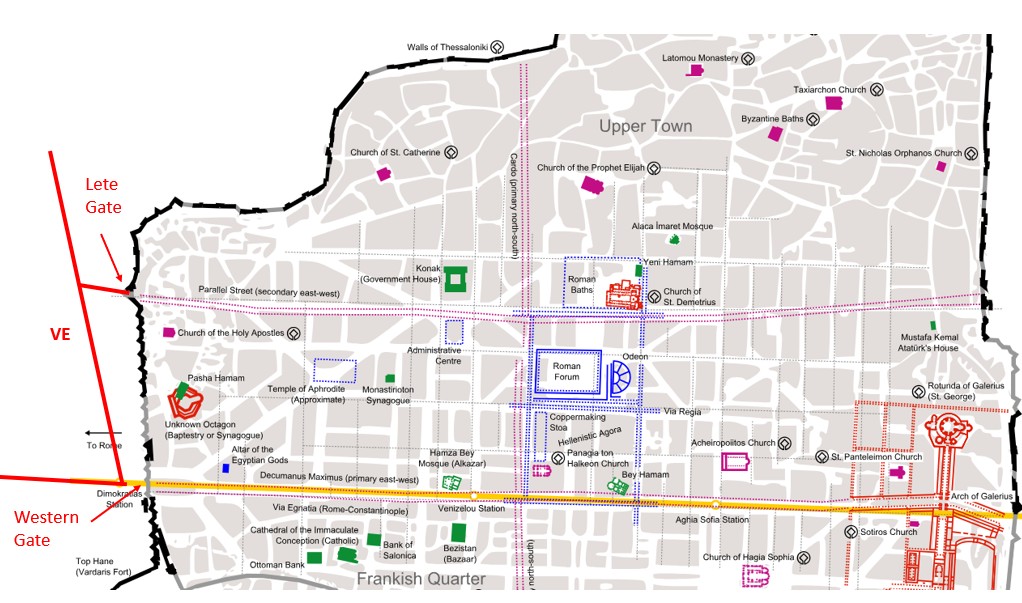
Thessalonica, like Philippi, was founded about 315 BC as a royal city by Cassander who named it after his wife, Alexander the Great’s half-sister. Protected by mountains to the north and with a good harbor on the Thermaic Gulf, it was an ideal location for a prosperous city. In the century and a half that followed it became one of Macedonia’s most important centers, with the Macedonian king often residing there in a splendid palace. After the Roman conquest and reorganization, it became the capital of the second μέρις of Macedonia, still growing and expanding. Finally, the city’s refusal to aid Brutus and Cassius in their battle with Octavian and Anthony resulted in it becoming a civitas libera (free city) in 42 BC, thus no longer paying normal taxes to Rome or having a Roman military force present. Strabo (7.7.4), writing a generation before Paul’s visit, states that it was the largest city of Macedonia, although it was not as large as it would become in the fourth century when it became the seat of one of the Diocletianic tetrarchs.
Thessalonica in the Roman period had a Jewish community, and so it was natural that Paul “as it had become his custom, went into the synagogue.”1 He made it the center of his outreach ministry and returned for two successive Sabbath days (Acts 17:2). His preaching bore fruit among some Jews, God-fearing Greeks, and prominent women (17:4). Envious Jews, however, disrupted Paul’s ministry and dragged some of the new believers including Jason before the local authorities again called politarchs (17:6).2 The charge of preaching another king or emperor (βασιλεύς) was well-chosen to be especially disturbing (17:7) in a Macedonian city once the residence of numerous pre-Roman kings and now the capital of the Roman province of Macedonia. Apparently, the prominent female converts were unable to influence the authorities in Paul’s favor, and so his initial ministry came to an abrupt end. Nevertheless, as Adam-Veleni and Flora Karagiani note about Thessalonica, “the passage of the Apostle Paul determined its religious evolution as one of the major ecclesiastical centres of the first Christian centuries.”3
Created by GMT & JTS
Last updated 11/13/2025 JTS
- The earliest archaeological evidence for a synagogue building comes from the Second Century AD; see Nigdelis, Pantelis M. “Synagoge(n) Und Gemeinde Der Juden in Thessaloniki: Fragen Aufgrund Einer Neuen Jüdischen Grabinschrift Der Kaiserzeit.” Zeitschrift Für Papyrologie Und Epigraphik 102 (1994): 297–306. ↩︎
- King, Carol J. “Macedonian Kingship and Other Political Institutions.” Essay. In A Companion to Ancient Macedonia, 371–91. Malden: Wiley-Blackwell, 2010, p. 390. ↩︎
- Adam-Veleni, Polyxeni, and Flora Karagianni. “Village Life in the Macedonian Hinterland of Thessaloniki.” Essay. In The Village in Antiquity and the Rise of Christianity, edited by Alan Cadwallader, James R Harrison, Angela Standhartinger, and L. L. Welborn, 294–321. London: T&T Clark, 2024, p. 318. ↩︎